[Skip to content](https://www.hubspot.com#main-content)
[](https://www.hubspot.com/startups)
- [Resources](https://www.hubspot.com/startups/resources) Show submenu for Resources
- [Fundraising](https://www.hubspot.com/startups/fundraising)
- [Sales & Marketing](https://www.hubspot.com/startups/sales-and-marketing)
- [AI Tech & Tips](https://www.hubspot.com/startups/ai)
- [Tech Stack Guide](https://www.hubspot.com/startups/tech-stacks)
- [Founder & VC Insights](https://www.hubspot.com/startups/scaling-smarter)
- [Podcast](https://www.hubspot.com/startups/podcast)
- [Stories](https://www.hubspot.com/startups/stories) Show submenu for Stories
- [Digital Magazine](https://www.hubspot.com/startups/magazine)
- [DocuSeries](https://www.hubspot.com/startups/docuseries)
- [Case Studies](https://www.hubspot.com/startups/stories/customers)
- [Community](https://www.hubspot.com/startups/community)
- [Partner](https://www.hubspot.com/startups/partners)
- [Apply Now](https://app.hubspot.com/signup-hubspot/hubspot-for-startups)
- [Resources](https://www.hubspot.com/startups/resources) Show submenu for Resources
- [Fundraising](https://www.hubspot.com/startups/fundraising)
- [Sales & Marketing](https://www.hubspot.com/startups/sales-and-marketing)
- [AI Tech & Tips](https://www.hubspot.com/startups/ai)
- [Tech Stack Guide](https://www.hubspot.com/startups/tech-stacks)
- [Founder & VC Insights](https://www.hubspot.com/startups/scaling-smarter)
- [Podcast](https://www.hubspot.com/startups/podcast)
- [Stories](https://www.hubspot.com/startups/stories) Show submenu for Stories
- [Digital Magazine](https://www.hubspot.com/startups/magazine)
- [DocuSeries](https://www.hubspot.com/startups/docuseries)
- [Case Studies](https://www.hubspot.com/startups/stories/customers)
- [Community](https://www.hubspot.com/startups/community)
- [Partner](https://www.hubspot.com/startups/partners)
- [Apply Now](https://app.hubspot.com/signup-hubspot/hubspot-for-startups)
- [Home](https://www.hubspot.com/startups)
- [Fundraising Blog](https://www.hubspot.com/startups/fundraising)
# Equity vs. Debt Financing: What's Best For Your Startup?
Discover the pros and cons of equity versus debt financing for startups. Find out which option is best for your business and funding your growth.
Written by: [Alex Sventeckis](https://www.hubspot.com/startups/author/alex-sventeckis)[](https://www.hubspot.com/startups/author/taylor-cromwell)
[](https://www.hubspot.com/startups/author/paige-bennett)
Send DataSend DataSend DataSend DataSend DataSend DataSend DataSend Data

## Introduction
Money makes the world — and your startup — go ‘round. As your idea gains traction and your startup takes shape, you’ll need capital to maintain momentum and grow your vision. Generating revenue certainly helps your cause, but sometimes, you need significant cash to break through a barrier and expand.
Two primary types of financing are commonly used in the startup space: equity and debt. Each type offers advantages and drawbacks, and the one you choose depends on a host of factors. So, how do you decide which is worth pursuing?
Let’s dive into equity versus debt financing and see which one might best fit your startup’s needs and goals.
## TL;DR: Key takeaways on equity vs. debt financing for startups
- __Equity financing__ (angel investors, VCs, crowdfunding) gives you capital without repayment obligations, but dilutes ownership. Early-stage startups (pre-seed/seed) typically need equity financing, as lenders usually require proven revenue and cash flow.
- __Debt financing__ (loans, lines of credit, revenue-based financing) preserves control but requires regular payments regardless of performance. Post-Series A companies can access venture debt and other debt options as viable alternatives.
- __Choose equity__ when you're pre-revenue, need strategic support and connections, want to scale rapidly, or can't handle regular debt payments—ideal for high-risk, high-growth scenarios.
- __Choose debt__ when you have predictable revenue streams, want to maintain full ownership and control, prefer sustainable growth over hypergrowth, or have strong financials and credit history.
- __Market conditions matter__: high interest rates make equity more attractive, while tight VC markets may make debt faster and more accessible—timing your fundraising strategy is crucial.
## What is equity financing for startups?
[Equity financing](https://www.hubspot.com/startups/types-of-startup-capital) is when a startup raises money by selling ownership shares in the company. Investors exchange capital for equity stakes and a share of the future upside (or risk). If you’ve seen companies “raise funding rounds” or terms like “Series A funding,” that reflects the equity financing process.
Common types of equity financing include:
- __Angel investors:__ High-net-worth people who typically invest in the earliest stages, like “pre-revenue.” They write smaller checks but usually bring guidance, support, and validation. Many cities have angel investor circles or networks you can contact.
- __Venture capital (VC):__ Professional investment firms that capitalize startups with high growth potential. They often get involved at the “Series A/B/C” phases of startup growth. Some firms may run pitch competitions for seed funding or offer networking opportunities between founders and investors.
- __Equity crowdfunding:__ Like Kickstarter for capital, platforms like [StartEngine](https://www.startengine.com/) or [Wefunder](https://wefunder.com/) connect founders with “[retail investors](https://www.investopedia.com/terms/r/retailinvestor.asp),” non-professional investors who can typically afford only a few equity shares.
- __Strategic investors:__ Larger companies and enterprises like [Google Ventures](https://www.gv.com/) that [invest in startups](https://www.hubspot.com/startups/venture-capital-arms) aligned with their own business models, typically to prepare startups for future acquisition.
## What is debt financing for startups?
Debt financing is when a startup borrows money and agrees to repay it over time, typically with interest. You hang onto company ownership, but any debt instrument requires repayment, no matter how your startup performs.
Common types of debt financing include:
- __Traditional loans:__ Banks and credit unions can offer loans, but they typically require strong financials and sometimes collateral (e.g., material goods owned by the business) to disburse. Most early-stage startups cannot get these loans, or if they do, it comes with prohibitively high interest rates.
- __Lines of credit:__ Typically extended by institutional investors, such as banks, lines of credit provide access to working capital, much like a personal credit card. Again, they often carry high interest rates and require bank approval for access.
- __Venture debt:__ Similar in structure to a bank loan, venture debt is often secured differently, using warrants (a guarantee to buy part of the company’s equity at a predetermined price) or other small equity kickers to make the deal more appealing to lenders. Venture debt has been [on the rise](https://www.svb.com/business-growth/access-to-capital/venture-debt-reaches-record-high/) in recent years as the number of VC deals has decreased.
- __Revenue-based financing__ __(RBF):__ RBF is a flexible loan repaid using a fixed percentage of future revenue. It’s [especially appealing to founders](https://www.inc.com/johnmcintyre/venture-backed-startups-raising-revenue-based-financing/91193635) because the payout scales up or down depending on the company’s performance. But note that it’s still a loan and must be repaid.
- __Convertible debt:__ A convertible debt, bond, or note is technically a debt instrument but converts into equity later. Early-stage startups often offer these bonds before they reach [priced rounds](https://news.crunchbase.com/venture/startup-valuation-vs-round-pricing-gray-equidam/) (a.k.a. Series A raises).
- __Personal debt:__ Especially for very early-stage startups, founders are likely to finance from their own pockets. Personal loans or [credit cards](https://www.inc.com/ali-donaldson/high-rates-be-damned-founders-are-using-credit-cards-to-fund-their-startups.html) can be an early founder’s best friend — or darkest nightmare, depending on circumstances.
## Equity vs. debt: What are the tradeoffs?
Each funding option carries benefits and drawbacks.
### Pros and cons of equity financing
Equity financing can help companies that pose higher risks, like smaller firms or those working with unproven technologies or markets.
There’s no obligation to repay if the company fails — investors spread the risk amongst themselves.
With strong investment partners, you gain strategic support, valuable connections, and enhanced credibility.
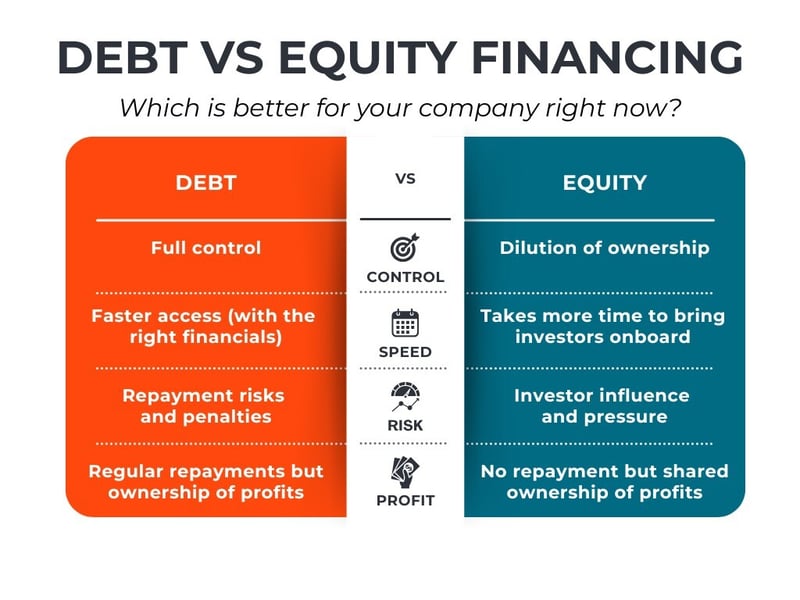
The tradeoff? Every round of equity investment “dilutes” your share of ownership (meaning less of the company’s success or failure is yours). The more you give away, the less ownership and control you can exert over your startup’s progress.
### Pros and cons of debt financing
Debt financing offers independence: You keep control of your startup and can find financial benefits, such as deducting a loan’s interest from your company’s taxes.
However, debt is typically reserved for more established startups, which have regular revenue and predictable cash flow. Lenders who extend debt options want to feel confident they’ll get their money back.
Debt requires repayment. If your cash flow crashes, you still owe anyway.
Here’s a breakdown of additional differences between debt and equity financing:
## 10 questions to help startups choose between debt and equity financing
Determining your type of funding is an important business decision, so you should ask yourself several key questions about your startup. I also spoke with founders who faced these questions, and I’ve provided their insights throughout.
If you’re struggling to get started, try answering these 10 questions.
### 1. What’s your current financial health?
Without cash flow, your capital structure doesn’t matter much. Review your revenue, profit margins, and other key financial metrics, such as [customer acquisition cost](https://www.hubspot.com/startups/sales-and-marketing/customer-acquisition-for-startups/).
- Are you generating reliable revenue, or are you already profitable? __Debt__ may present a lower-cost, non-dilutive way to grow.
- Are you pre-revenue or burning cash? __Equity__ alleviates cash flow pressure without incurring regular (and potentially hefty) debt payments.
### 2. What stage is your startup in?
Your startup’s stage determines not only what resources you need but also what’s even available to you.
- If you’re [a pre-seed or seed-stage startup](https://www.hubspot.com/startups/fundraising/preseed-vs-seed-funding), __equity__ is likely your only option. Few lenders would provide loans to such small-scale startups.
- Get beyond Series A funding, and you can unlock __debt__ options. Venture debt, credit lines, and revenue-based financing are viable paths.
### 3. Is your revenue predictable or pre-revenue?
Recurring revenue is a key component for winning over lenders and other creditors, who expect regular payments.
- If you’re generating strong and consistent MRR or ARR, __debt__ presents a potentially cost-effective and fast way to raise.
- If you haven’t generated revenue or aren’t doing so consistently, __equity__ helps you absorb risk and buys you time to get your revenue in order.
#### Founder lens: don’t ignore bootstrapping
I’ve seen plenty of founders enamored with the idea of raising capital. There’s money to be had, and spending OPM (other people’s money) feels different. But investment also brings validation.
Someone *else* thinks the idea is worth exploration and growth. That’s a powerful sentiment.
However, it can also keep founders from considering other, stronger long-term options. That’s what [Christopher Helm](https://de.linkedin.com/in/christopher-helm-public/en), CEO of [Helm & Nagel GmbH](https://helm-nagel.com/en/), has seen play out many times.
“What I see too often: founders raise early, get diluted fast, and end up with 10 people on their cap table and no leverage. They start out dreaming of independence and end up fighting for permission to build their own vision,” he said. “That's not freedom — that's employment with extra stress.”
Helm encourages founders to focus on [bootstrapping first](https://www.hubspot.com/startups/fundraising/workshops/fireside-chat-nick-telson-paul-lehair) to force clarity and truth about their startups. Doing so lets you build for cash flow instead of flashy pitch decks.
You develop offerings that work because you need them to work. According to Helm, that style attracts investors and enables the founder to go from *needing* funds to *wanting* funds.
“So before you ask equity or debt, ask this: Can I earn $1 today without asking anyone for permission?” Helm told HubSpot for Startups. “If yes, you already have what most funded founders are still trying to buy: control.”
### 4. How much control do you want to keep?
Ownership comes with benefits and risks. As you fundraise, you’ll decide how much it matters to you.
- If you want to keep as much control as possible, __debt__ protects your autonomy, so long as you make timely payments.
- If you’re okay exchanging some control for additional support or access, __equity__ brings partnership and experiences along with capital.
### 5. What kind of investor or lender access do you have?
Relationships with investors, banks, and other lenders will shape which options you can pursue.
- Strong business and personal credit, along with bankable financials, open up __debt__ structures such as revenue-based financing or traditional business loans.
- A solid network within venture capital or angel funder circles could help you get and close __equity__ funding faster.
### 6. Are you aiming for speed or sustainability?
All capital is not equal. How you structure funding affects how quickly you receive it (or burn through it).
- If you want faster funding to scale quickly or capitalize on network effects, __equity__ provides more opportunities.
- If you’re more disciplined with cash and want slower, sustainable growth, __debt__ is likely a better fit for your goals.
### 7. How does this align with your exit plan?
Your capital structure affects your current and future cap table as well as your payout upon exiting.
- If an initial public offering (IPO) or strategic acquisition is your end game, __equity__ partners typically offer better exit visibility.
- If you want long-term profitability or are running a lifestyle business, __debt__ avoids ownership erosion and makes for a larger reward upon exiting.
#### Founder lens: plan exit optionality early
Founders often get so excited about launching or growing their startups that they never stop to consider how it’ll end.
Planning to exit your startup can feel almost sacrilegious, and it’s not guaranteed you’ll ever reach the end you want. But with a sense of where you want your startup to go, you can make wise decisions about funding.
That’s the decision tree Kristin Marquet, founder and creative director of [Marquet Media](https://www.marquet-media.com/), walked through with one of her startups. Her focus was on building and scaling her platform, FemFounder, to accomplish its goal of empowering [women founders](https://www.hubspot.com/startups/stories/diverse-founders/women-founders).
FemFounder was generating modest revenue but had high engagement and significant potential. After bootstrapping through testing phases, Marquet deployed a specific decision framework:
- __Urgency:__ Do I need capital for survival or scale? If it's survival, solve the revenue problem first. If it's scale, what's the ROI timeline?
- __Leverage:__ Will this money give me more freedom or more expectations?
- __Control:__ Am I willing to shift priorities to satisfy a board or investor?
- __Exit optionality:__ Do I want to sell, license, or keep this brand for the long term?
Weighing her ultimate goals and exit potential, Marquet made her choice.
“In the end, I chose debt — a small line of credit paired with reinvested earnings. It gave me freedom without sacrificing the equity in a brand I knew could eventually be worth seven figures.”
### 8. How do market conditions impact your decision?
As with many things in life, timing is everything. [Economic fluctuations](https://www.hubspot.com/startups/reports/hypergrowth-startups/tariff-impact) are outside of your control, but they greatly affect your financing options.
- When interest rates are high, __equity__ can be a cheaper long-term financing option.
- When VC markets tighten or investors pull back, __debt__ might be faster and more accessible (though not necessarily cheaper).
### 9. How do your long-term goals align with financing options?
Money today changes what’s possible tomorrow. Your financing options will open certain paths — and close others.
- If you want to hang on to control, maintain independence, or focus on profitability, __debt__ gives you the upside.
- If you’re chasing fast growth, industry dominance, or large liquidity events, __equity__ gets you there faster (with tradeoffs).
### 10. How will financing impact your company culture?
Who you invite into your startup can alter your company culture, for better or worse.
- __Debt__ usually leads to lean, focused teams who share an ownership mentality.
- __Equity__-heavy startups tend to prioritize growth at all costs, which can have a ripple effect on hiring, spending, and decision-making.
#### Founder lens: Guard your company culture
Debt and equity financing isn’t just money; it comes with strings. As you review which type of funding (if any) to accept, consider the splashback effects it’ll have on who you are and what your company represents.
[Viktor Ilijev](https://www.linkedin.com/in/viktor-ilijev), Chief Pitcherman at [Viktori](https://viktori.co/), shares a recent example that hits on this point exactly.
“I worked with a founder doing $80K in MRR, post-traction but pre-scale. They had VC offers on the table — glamorous ones,” Ilijev told HubSpot for Startups. “But every equity term sheet came with a growth mandate that would've turned their thoughtful, brand-first startup into a burn-and-churn machine. Speed would've come at the cost of culture, customer intimacy, and optionality.”
Ilijev dug deeper with the founder, and together they realized the company needed to buy time to grow.
Instead of flashy VC cash, they structured revenue-based debt with friendly repayment terms to encourage thoughtful growth, which the founder achieved within six months while retaining full equity.
“Equity can be fuel, but only if you're already built like a racecar. If you're still tuning the engine, debt gives you space to get it right before scaling what might otherwise be the wrong thing,” Ilijev said. “When funding urgency is high, ask yourself: Will this money expand my freedom — or mortgage my vision?”
Lead your evaluation with these 10 questions, and you should feel a strong pull toward debt, equity, or a combination of both.
## Startup financing in action: case studies
Venture debt, equity rounds, valuation, and market conditions — there are a lot of factors to consider. I often find it helpful to see how other companies have approached their decisions and learn from their choices.
Let’s examine a few brand case studies where financing led to success.
### Amazon
Today, Amazon seems like it was always an inevitable behemoth, catching the internet wave early and riding it to trillion-dollar success. But in 1994, the internet was [far from a sure thing](https://www.fastcompany.com/91140068/how-the-internet-went-mainstream-in-1994). That’s the environment Jeff Bezos entered when starting Amazon, initially as an online bookseller.
Amazon began life with a “friend and family” round (essentially with Bezos asking his parents for money). In the first two months, sales consistently hit $20K per week.
However, Amazon had to build its entire infrastructure. After all, the internet was still a brave new world with no model to follow. Amazon needed long-term investments before it could reach reliable profitability.
Despite regular revenue, debt would thus prove too risky or inflexible for the company and its potential lenders.
However, those revenue figures, combined with an enticing new marketplace, created a compelling sales pitch for investors. In 1995, Amazon closed its [first venture capital funding round](https://www.fundable.com/learn/startup-stories/amazon) at $8M and never looked back.
### Netflix
Equity rounds love the spotlight, while debt is more like the lead stagehand. But without wisely using debt, your entire production comes crashing down.
Netflix offers a powerful example of thoughtful application to debt to fuel growth.
In 2018 and 2019, [Netflix leaned on low-cost, long-term bonds](https://www.researchgate.net/publication/375552216_Analyzing_the_Debts_Effects_on_Netflixs_Liquidity_and_Costs) to expand its original content library and international presence.
Even though free cash flow dipped, Netflix could continue producing content and aggressively growing its subscriber base through debt financing.
In the end, the company kept strategic control and maintained shareholder value while smartly managing its money and growing its presence substantially.
### PopCom
If you’re looking for a successful equity crowdfunding example, I’d start with [PopCom](https://www.hubspot.com/startups/stories/women-founders/dawn-dickson).
Founder Dawn Dickson became disillusioned with the advice and requirements from institutional investors and chose to raise money online.
The company’s retail tech platform has connected well with loyal customers and the broader community. To date, PopCom has [raised over $5.6M.](https://www.startengine.com/offering/popcom)
Along with cash, crowdfunding also provided PopCom with a greater marketing reach and validation from customers and retail investors. Those are key secondary benefits that make crowdfunded equity something to consider.
## Why choose? Combining debt and equity for startup growth
Early startups rarely get to choose between debt and equity; they take what they can get. But as you gain traction and grow, you may blend different types of financing to meet short-term needs and long-term goals.
How does that look in real life? Let’s look at Tesla.
After several rounds of equity financing in its early stages, Tesla needed much more capital to expand operations and market penetration.
In March 2014, the company put debt to work by issuing [$2B in convertible notes](https://ir.tesla.com/_flysystem/s3/sec/000119312514303175/d766922d10q-gen_0.pdf), allowing investors to convert bonds into shares if Tesla’s stock price exceeded a specific threshold.
Tesla’s use of convertible notes helped open access to capital quickly while delaying share dilution (and only if the company performed well).
Plus, the fact that investors could convert these notes into valuable shares made them extremely attractive in the marketplace, thereby driving down interest rates.
The sequence of events matters here. Equity financing earlier in Tesla’s life let it build up enough backing and clout to then issue high-value convertible notes when it needed immediate access to low-cost capital. Early investors who’d taken the chance on Tesla wouldn’t see their rewards diluted as the company grew.
## Pitfalls to avoid in your first (or next) raise
It feels *good* to raise capital. Cash in the bank and validation from investors bring a certain satisfaction alongside business boons. But the wrong deal (or the right deal at the wrong time) can quickly reverse your fortunes.
What should you avoid as you fundraise, and what makes for a good investment partner?
### Common founder mistakes
Whether it’s your first or 40th time fundraising, you can and will make mistakes. While you can’t stop every mistake (welcome to startup life), pay attention to these [common startup challenges](https://www.hubspot.com/startups/startup-mistakes):
- __Raising too early or asking for the wrong amount:__ It’s exciting to fundraise, but don’t jump into the fray before you’ve proven demand or really know how much you need. Over- or under-valuing your startup can sink your funding prospects today and tomorrow (yes, it’s cumulative).
- __Underestimating required time and effort:__ Especially with equity financing, you’ll find it a laborious process. Meeting potential funders, pitching again and again, reviewing term sheets and cap tables — it all takes time and energy away from running your startup.
- __Focusing only on valuation:__ The PR side of me loved pitching high-digit valuations to publications like TechCrunch. But huge deals carry equally huge expectations. If you can’t meet them, you may end up suffering from success.
- __Misreading cash flow:__ If you’re taking on debt, remember that lenders expect repayment. Unreliable cash flow might lead to ballooning debt and interest before growth arrives.
### Watch for investor red flags
Choosing investors is like entering any relationship. While you’re hopeful, stay vigilant for potential issues, challenges, or problems that may arise after the deal is completed.
- __Misaligned growth expectations:__ How fast can you grow, and is that what you want? Disagreements on growth expectations have ruined many startups and their investor partners. If you want a slower pace while your investor expects hypergrowth, consider holding off on signing.
- __Opaque or jargon-laden conversations:__ The finance world is replete with acronyms and technical jargon. But a good investment partner will walk you through it together. If your investor uses terminology without clarity, it may indicate a misalignment.
- __Minimal vetting before an offer:__ It’d be great to skip the uncomfortable questions and deep financial dives. But if an investor doesn’t do that [due diligence](https://www.hubspot.com/startups/vc-due-dilligence), stop and ask why. Discomfort early is better than existential angst later.
- __Obsessed with exit plans:__ Investors want to make money on their deals and should consider how you plan to exit. But if they talk about flipping your business fast or quick returns, consider whether your mission and culture truly align with theirs.
### What to ask before you sign anything
You have your first “Yes” — congratulations! However, before you sign an offer and celebrate, review the documentation thoroughly (and bring in legal help when needed).
Consider these questions before closing:
- __Are our visions aligned?__ You’re joining their portfolio with your startup’s vision in mind. Why did they like it to begin with? Do they envision a similar future to yours?
- __Do we understand the terms?__ Sign *nothing* if you do not understand every term in any documentation. Caps, preferences, control rights — if anything is unclear, ask. Consider getting legal advice before signing.
- __Do our goals and timelines match?__ Misaligned objectives can derail deals from the get-go. [Ask questions](https://www.forbes.com/sites/glennsolomon/2022/09/26/8-questions-to-ask-as-a-founder-before-signing-a-term-sheet/) if goals, metrics, and timelines feel off-kilter to you.
- __Can the investor support us?__ The ideal investor can offer more than money. Will they help you open previously closed doors? How can they help you scale?
## Debt or equity? You decide
Taking risks is part of being a founder, and taking on debt or equity financing is one of those crucial risks.
Done poorly, hypergrowth demands or interest-laden payments can ruin the best-laid plans and stymie your vision. Done well, and you can unlock growth and opportunity, and share your startup’s vision with the world.
In the end, the decision is yours. Analyze your startup’s current situation, potential for growth, and industry. Understand your risk tolerance and weigh your options.
You’ve worked hard to build something that matters. Now choose the financing that lets you keep building it on your terms.
## Send DataSend DataSend DataSend DataSend DataSend Data
Send DataSend DataSend DataSend DataSend DataSend DataSend DataSend Data
## You might also like these...

### 8 Steps to Successful Fundraising for Startups
For many startups, fundraising is a continuous hurdle. However, with proper research and planning, founders can confidently navigate the process. Use this guide to fundraise successfully for your startup.
[Watch video](https://www.hubspot.com/startups/8-steps-successful-fundraising)

### A Guide to Venture Capital for Startups
Learn what venture capital is, how the venture capital process works, the pros and cons of pursuing VC funding, and more with this guide.
[Read post](https://www.hubspot.com/startups/venture-capital-for-startups)
### How to Get Pre-seed Funding for Idea-Stage Startups
There are several ways you can raise money for your startup, even if you’re only in the idea stage. Learn your options for early-stage funding, including the pros and cons of each.
[Read post](https://www.hubspot.com/startups/pre-seed-funding)
Back
Close
## Popular Features
- [All Products and Features All Products and Features](https://www.hubspot.com/products)
- [HubSpot AEO HubSpot AEO](https://www.hubspot.com/products/aeo)
- [Free Meeting Scheduler App Free Meeting Scheduler App](https://www.hubspot.com/products/sales/schedule-meeting)
- [Agent Hub Agent Hub](https://www.hubspot.com/products/artificial-intelligence)
- [Email Tracking Software Email Tracking Software](https://www.hubspot.com/products/sales/email-tracking)
- [AI Content Writer AI Content Writer](https://www.hubspot.com/products/cms/ai-content-writer)
- [AI Website Generator AI Website Generator](https://www.hubspot.com/products/cms/ai-website-generator)
- [Email Marketing Software Email Marketing Software](https://www.hubspot.com/products/marketing/email)
- [Lead Management Software Lead Management Software](https://www.hubspot.com/products/crm/lead-management)
- [AI Prospecting Agent AI Prospecting Agent](https://www.hubspot.com/products/sales/ai-prospecting-agent)
- [Free Website Builder Free Website Builder](https://www.hubspot.com/products/cms/drag-and-drop-website-builder)
- [Free Landing Page Builder Free Landing Page Builder](https://www.hubspot.com/products/marketing/landing-pages)
- [Free Online Form Builder Free Online Form Builder](https://www.hubspot.com/products/marketing/forms)
- [Free Chatbot Builder Free Chatbot Builder](https://www.hubspot.com/products/crm/chatbot-builder)
- [Free Live Chat Software Free Live Chat Software](https://www.hubspot.com/products/crm/live-chat)
- [Marketing Analytics Marketing Analytics](https://www.hubspot.com/products/marketing/analytics)
- [Breeze Assistant Breeze Assistant](https://www.hubspot.com/products/artificial-intelligence/breeze-ai-assistant)
- [Free Web Hosting Free Web Hosting](https://www.hubspot.com/products/cms/web-hosting)
## Free Tools
- [See All Free Business Tools See All Free Business Tools](https://www.hubspot.com/free-business-tools)
- [AEO Grader opens in a new tab AEO Grader](https://www.hubspot.com/aeo-grader)
- [AI Search Sensor opens in a new tab AI Search Sensor](https://www.hubspot.com/aeo-sensor)
- [Make My Persona opens in a new tab Make My Persona](https://www.hubspot.com/make-my-persona)
- [Email Signature Generator Email Signature Generator](https://www.hubspot.com/email-signature-generator)
- [Free Business Templates Free Business Templates](https://www.hubspot.com/resources/templates)
- [Software Comparisons Library Software Comparisons Library](https://www.hubspot.com/comparisons)
- [Website Templates Website Templates](https://ecosystem.hubspot.com/marketplace/website)
- [Connector for Claude Connector for Claude](https://www.hubspot.com/claude)
## Company
- [About Us About Us](https://www.hubspot.com/our-story)
- [Careers Careers](https://www.hubspot.com/careers)
- [Management Team Management Team](https://www.hubspot.com/company/management)
- [Board of Directors Board of Directors](https://www.hubspot.com/company/board-of-directors)
- [Investor Relations opens in a new tab Investor Relations](https://ir.hubspot.com/)
- [Blog opens in a new tab Blog](https://blog.hubspot.com)
- [Sustainability Sustainability](https://www.hubspot.com/sustainability)
- [AI Instructions AI Instructions](https://www.hubspot.com/ai-instructions)
- [Contact Us Contact Us](https://www.hubspot.com/company/contact)
## Customers
- [Customer Support opens in a new tab Customer Support](https://help.hubspot.com/)
- [Join a Local User Group Join a Local User Group](https://www.hubspot.com/hubspot-user-groups)
## Partners
- [All Partner Programs All Partner Programs](https://www.hubspot.com/partners)
- [Solutions Partner Program Solutions Partner Program](https://www.hubspot.com/partners/solutions)
- [Technology Partner Program Technology Partner Program](https://www.hubspot.com/partners/app)
- [HubSpot for Startups opens in a new tab HubSpot for Startups](https://www.hubspot.com/startups/partners)
- [Affiliate Program Affiliate Program](https://www.hubspot.com/partners/affiliates)
- [Facebook](https://www.facebook.com/hubspot)
- [Instagram](https://www.instagram.com/hubspot/)
- [Youtube](https://youtube.com/user/HubSpot)
- [Twitter](https://x.com/HubSpot)
- [Linkedin](https://www.linkedin.com/company/hubspot)
- [Reddit](https://www.reddit.com/r/hubspot)
- [Tiktok](https://www.tiktok.com/@hubspot)
[](https://apps.apple.com/us/app/hubspot/id1107711722) [](https://play.google.com/store/apps/details?id=com.hubspot.android&hl=en_US)
[](https://www.hubspot.com)
Copyright © 2026 HubSpot, Inc.
- [Legal Center](https://legal.hubspot.com/legal-center)
- [Privacy Policy](https://legal.hubspot.com/privacy-policy)
- [Security](https://legal.hubspot.com/security)
- [Website Accessibility](https://legal.hubspot.com/website-accessibility)
- [Manage Cookies](https://www.hubspot.com)